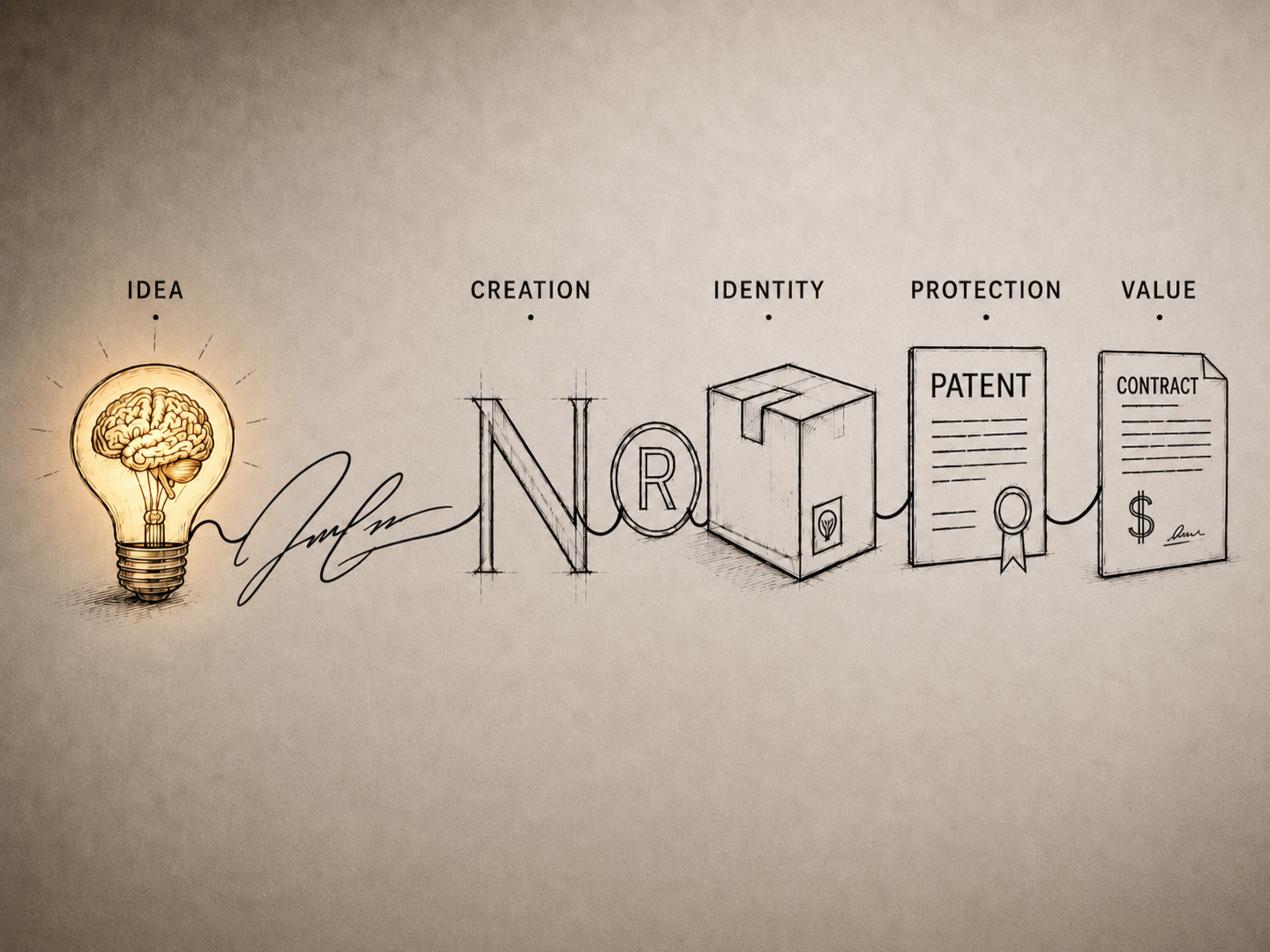
IP Protection Is Not a Legal Formality. For a Startup, It Is the Foundation of Competitive Advantage
When a founder names a company, writes the first line of code, invents a process, or designs a logo, they may be creating an asset protected under Intellectual Property Law in Sri Lanka.
A business may spend years developing a name, product, logo, design, invention, or creative work. It may invest in branding, packaging, marketing, staff, suppliers, customer relationships and market entry. Over time, that asset may begin to carry real commercial value. Customers may recognise it. Distributors may request it. Investors may take interest in it. Competitors may begin to notice it.
Problems often arise when legal protection is left for later.
Another party may begin using a misleadingly similar name. A former partner may claim rights over a logo or product design. A manufacturer may imitate the appearance of a product. A third party may file a trademark application before the original business does. A foreign company entering Sri Lanka may discover that its brand has already been registered, copied, or challenged locally.
By that stage, the matter is no longer limited to ownership on paper. It may affect reputation, sales, expansion, investor confidence and the ability to succeed through legal action.
Intellectual property protection should therefore be treated as part of sound business planning. When valuable assets are left unprotected, the business may lose control over the work, goodwill, and market position it has built.
What is considered intellectual property?
The Intellectual Property Act No. 36 of 2003 (as amended) is the main law governing intellectual property protection in Sri Lanka. It recognises several categories of protected rights, including copyright, patents, trademarks, trade names, trade secrets, industrial designs, layout designs of integrated circuits, and geographical indications.
Each category protects a different type of business asset.
Copyright: Protection From the Moment of Creation
Unlike many other IP rights, copyright in Sri Lanka arises automatically upon the creation of an original work. Copyright protects the expression of an idea, not the idea itself and no registration is required.
Protected works may include books, articles, computer programs, musical compositions, photographs, films, software coding, architectural drawings and broadcasts. For a startup, this means that source code, product documentation, marketing materials, and website content may be protected from the day they are created.
Copyright generally lasts for the life of the author plus 70 years, allowing valuable creative assets to remain protected for the long term. Sri Lanka is also a signatory to the Berne Convention, which supports the reciprocal recognition of Sri Lankan copyright protection in many other countries.
Patents: Protecting What You Invent
A patent gives its holder the exclusive right to commercially exploit an invention for up to 20 years from the date of filing, in return for publicly disclosing how the invention works.
Under the IP Act, a patentable invention must be new, involve an inventive step, and be capable of industrial application.
For many startups, the cost, time, and technical process involved in obtaining a patent may lead to delay. This is a strategic miscalculation. Patent rights are generally priority-based, meaning that the timing of the application is significant. A competitor who files before you can legitimately block you from your own innovation.
Startups developing new technology, products, processes, or technical solutions should consider speaking to a lawyer specialising in patents early, especially before public disclosure, investor discussions, product testing, or market launch.
Trademarks: Your Brand Is a Business Asset
A trademark is any visible sign, such as a word, logo, colour, shape, or combination of these, that is capable of distinguishing the goods or services of one business from those of another.
Although prior use of an unregistered trademark may be recognised under Intellectual Property Law in Sri Lanka, registration with NIPO grants exclusive rights for an initial period of 10 years and may be renewed every 10 years indefinitely. This means a well-maintained trademark is potentially one of the most durable IP assets a startup can own.
The commercial logic is straightforward. Investors value brands. Acquirers may pay premiums for brands. Consumers trust brands. A registered trademark is the legal instrument that makes a brand defensible and early advice from a lawyer specialising in trademarks, can help a startup assess whether its name, logo, or other brand elements are available for use and registration and how to best commercialise it.
Without proper protection, another party may register a confusingly similar mark and operate in the same market, forcing a costly rebrand or litigation.
Tradename: Safeguard Your Business Name Through Use
Regardless of whether a trade name has been registered, its use in business may give it a degree of protection against third-party infringement.
However, many businesses do not take active steps to protect their trade name in the early stages. This can dilute the brand over time and may allow competitors, or businesses with similar names, to operate in the same market.
Trade Secrets: Protect What You Cannot Patent
Not every competitive advantage is patentable, and not every founder will want the public disclosure that comes with a patent.
Algorithms, customer lists, pricing strategies, formulas, processes, and internal methods may all carry commercial value because they remain confidential. Protection in these cases is maintained through internal confidentiality measures, employment agreements, contractor agreements, and non-disclosure agreements, rather than registration.
Industrial Designs: When Appearance Gives a Competitive Advantage
For startups in consumer products, fashion, furniture, packaging, app design, and hardware, industrial design registration can be a valuable form of IP protection. A product’s visual identity may be as commercially important as its function, especially where appearance influences customer choice.
Industrial design protection may apply to the ornamental or aesthetic aspects of an article. This can include features of shape, configuration, pattern, lines, colours, or any combination of these, whether two-dimensional or three-dimensional.
To be registrable, the design must meet the legal requirements. This generally includes novelty, meaning the design should not have been disclosed to the public anywhere in the world before the date of application, subject to any applicable grace periods.
Once registered, the owner has exclusive rights to use the design commercially during the protected period. This may include the right to manufacture, sell, import, or export products bearing that design.
Layout Designs of Integrated Circuits: Protecting the Architecture of Technology
Layout designs of integrated circuits, also known as semiconductor topographies or chip designs, are a specialised but increasingly relevant category of IP for technology-focused startups.
They refer to the three-dimensional arrangement of electronic elements, such as transistors, resistors, conductors, and related components, embedded or encoded in an integrated circuit product.
This form of protection recognises that the design of a semiconductor chip may itself be an original intellectual creation, separate from the chip’s function, which may be protected by patents, and its code, which may be protected by copyright.
For startups involved in hardware engineering, IoT product development, embedded systems, or fabless semiconductor design, layout design protection can be an important but easily overlooked asset. The 10 year protection term, originality requirement, and territorial nature of these rights mean that early planning is important, especially where manufacturing or export markets are involved.
Geographical Indications: Origin as a Mark of Quality
Geographical Indications, or GIs, protect signs that identify a product as originating from a particular territory, region, or locality, where a specific quality, reputation, or characteristic of the product is linked to its geographical origin.
Sri Lanka now has a dedicated national GI registration system, bringing local protection closer to its TRIPS obligations and international practice.
GIs are most often associated with agricultural and artisanal products. Ceylon Tea, Ceylon Cinnamon, and Dumbara Mats are among Sri Lanka’s internationally recognised examples.
For startups, GIs may be relevant in two ways. First, businesses in food, beverage, cosmetics, wellness, agriculture, or artisanal products that source or market products with genuine geographic links may consider whether GI registration adds value and authenticity to the brand.
Secondly, startups that are not GI owners should ensure that their product names, packaging, and marketing claims do not misuse protected GIs. Misuse may amount to an offence under the Act and can expose a business to injunctions, damages, and reputational harm.
Why IP Value and Protection Matter for Startups
IP is not an abstract legal concern. It can have direct business consequences throughout a startup’s lifecycle.
- Investor Due Diligence: Investors and venture capital firms often conduct IP audits before closing a funding round. Poorly documented or unprotected IP may raise concerns and reduce valuation. A strong IP portfolio can support defensibility and long-term enterprise value.
- Revenue Generation: IP can be monetised through licences, royalties, franchises, and co-development agreements. A startup that owns its IP may generate income from those rights without giving up equity.
- Competitive Moats: Registered IP can deter copycats and limit what competitors can do. A well-timed patent filing, trademark registration, or industrial design registration can help protect important product features, names, and designs.
- Mergers & Acquisitions: In technology and consumer sectors, acquirers may pay premiums for clear IP ownership. Startups that have not formalised their IP portfolio may later find that valuable assets are not legally owned by the company.
- Preventing Ownership Disputes: Many Sri Lankan startups are built by co-founders, freelancers, and contracted developers. Without clear IP assignment agreements, the creators may retain rights in the IP they produce. Ensuring that IP is vested in the correct person or company from the beginning is essential.
Common IP Risks for Startups
The Sri Lankan Intellectual Property Act provides strong protections, but these protections do not operate automatically in every case. Startups must take active steps to protect their own IP and avoid infringing the rights of others.
Common risks include delayed filings, difficulty proving copyright ownership, weak contracts with employees or stakeholders, unsecured domain names, and lack of proactive enforcement. Startups may also face liability through non-compliance with licence terms, use of stock images without proper rights, or operating without the required licences.
These issues are easier to address early, with proper legal advice, than during a growth phase, funding round, or dispute.
IP and Cross-Border Expansion
Many startups plan for cross-border expansion from an early stage. IP should form part of that planning.
A startup should consider which entity will own the IP, which jurisdiction will hold the rights, and where protection is needed. Protection should also be considered before public disclosures, market entry, fundraising, licensing, franchising, manufacturing, or appointing overseas partners.
Rights secured under Intellectual Property Law in Sri Lanka are generally territorial and may not protect the business in another country. Strategic registration, IP audits, market mapping, and ownership structuring can therefore help protect the commercial value of the startup as it expands.